




Coral TPU M.2 Dual Edge Accelerator Module
Coral TPU M.2 Dual Edge Accelerator Module doubles the inferences per second (8 TOPS). The module is an M.2 module (E-key) with two Edge TPU ML accelerators, each with an individual PCIe Gen2 x1 interface. For example, this can be accomplished by running two models in parallel or pipelining one model across both Edge TPUs. The small (22.0mm x 30.0mm x 2.8mm) module accelerates TensorFlow Lite modules in a power-efficient manner using 2 watts of power (2 TOPS per watt). One Edge TPU can execute state-of-the-art mobile vision models such as MobileNet v2 at almost 400 frames per second. The Coral M.2 Accelerator with Dual Edge TPU on-device machine-learning processing reduces latency, increases data privacy, and removes the need for a constant internet connection.
This module uses two PCIe x1 connections and it is not compatible with all M.2 E-key card slots. There are also special power requirements. Full power requirements can be found on the datasheet.
Coral, Google's platform for on-device AI, offers hardware components, software tools, and pre-compiled models for building intelligent devices.
Features
- 2x Google Edge TPU ML accelerator
- 8 TOPS total peak performance (int8)
- 2 TOPS per watt
- Integrated power management
- 2x PCIe Gen2 x1 interface (one per Edge TPU)
- M.2-2230-D3-E module
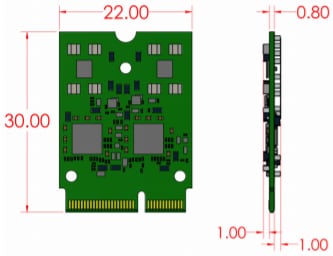
- 22.0 x 30.0 x 2.8mm
- -40 to +85°C Operating temperature
Applications
- Add to products with a compatible M.2 E-key slot
- Embedded platforms
- Mini-PCs
- Industrial gateways
Specifications
- 2.5g
- 3.3V ±10% DC supply
- -40 to +85°C storage and operating temperature
- 0% to 90% (non-condensing) relative humidity
- 1kV HBM, 250V CDM ESD
- Shock
- 100G, 11ms (persistent)
- 1000G, 0.5ms (stress)
- 1000G, 1.0ms (stress)
- Vibration (random/sinusoidal)
- 0.5Grms, 5Hz - 500Hz (persistent)
- 3Grms, 5Hz - 800Hz (stress)
Card Module Dimensions (in millimeters)
Required Equipment
- A computer with one of the following operating systems:
- Linux Debian 10, or any derivative thereof (such as Ubuntu 18.04), and a system architecture of either x86-64 or Armv8 (64-bit)
- Windows 10 (64-bit) and an x86-64 system architecture
- At least one available Mini PCIe or M.2 module slot
- Python 3.5, 3.6, or 3.7
All Coral Accelerators
Coral Edge TPU ML Accelerator Modules
Designed to execute neural network processing for machine learning at high speed and low power cost.
Yayınlandı: 2020-09-21
| Güncellenmiş: 2024-10-21