




Texas Instruments TMP61/TMP61-Q1 Silicon Linear Thermistors
Texas Instruments TMP61/TMP61-Q1 Silicon Linear Thermistors have a linear positive temperature coefficient (PTC) that results in a uniform, consistent temperature coefficient resistance (TCR) across a wide operating temperature range. These devices are designed for temperature measurement, protection, compensation, and control systems. Compared to traditional NTC thermistors, the TMP61/TMP61-Q1 offers enhanced linearity and consistent sensitivity across the entire temperature range. These devices also have robust performance due to the device's immunity to environmental variation and built-in fail-safe behavior at high temperatures. These devices are currently available in a 2-pin, surface-mount, 0402 footprint-compatible X1SON package and a 2-pin, through-hole, mini-sized transistor-outline TO-92S package. The Texas Instruments TMP61-Q1 devices are AEC-Q100 qualified for automotive applications.
Features
- Silicon-based thermistor with a Positive Temperature Coefficient (PTC)
- Linear resistance change with temperature
- Simplifies resistance-to-temperature conversion
- Decrease accuracy spread compared to non-linear Negative Temperature Coefficient (NTC) thermistor-based circuits across a wide temperature range
- 10kΩ nominal resistance at 25°C (R25)
- ±1% maximum (0°C to 70°C)
- Consistent sensitivity across temperature
- 6400ppm/°C TCR (25°C)
- 0.2% typical TCR tolerance across temperatures (-40°C to 125°C)
- Wide operating temperature
- –65 to +150°C
- Fast thermal response time
- 0.6s (DEC package)
- Long lifetime and robust performance
- Ultra-low power consumption compared to traditional NTCs that lower errors due to self-heating
- Built-in fail-safe in case of short circuit failures
- <1% maximum drift after high temperature and high humidity stress tests
- Available package options
- X1SON (DEC/0402 footprint)
- TO-92S (LPG)
Applications
- Temperature measurement and monitoring
- Thermal compensation
- Thermal protection (with comparator)
Datasheets
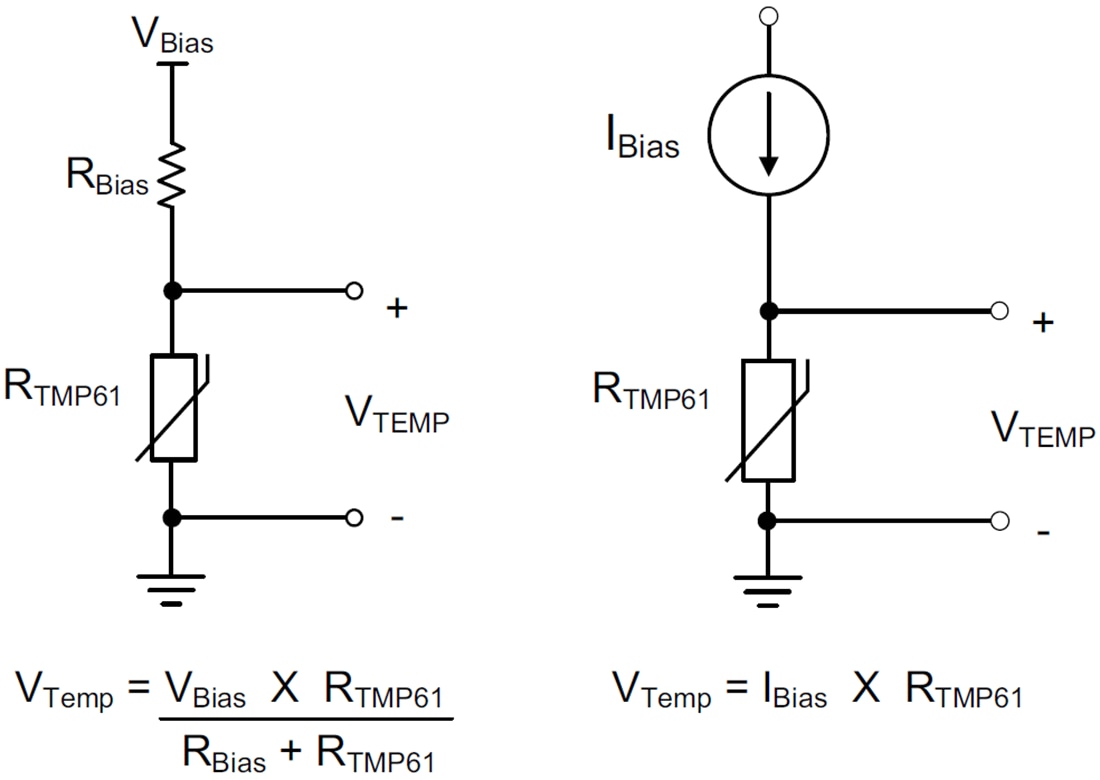
Functional Block Diagram
Development Tools

Texas Instruments TIDA-010208 Battery Pack Reference Design
Provides high accuracy for each cell voltage, pack current, cell, and MOSFET temperature.

Texas Instruments TIEVM-MTR-HVINV MCU Evaluation Module (EVM)
This module is a 750W development board for high-voltage motor drive applications.

Texas Instruments TMP6EVM Evaluation Module (EVM)
A plug and play system to test and evaluate the linear silicon TMP6 thermistor.
Yayınlandı: 2019-03-13
| Güncellenmiş: 2025-03-13